A guided journal for women is a notebook with prompts that help you reflect on your needs, choices, and next steps. If you’re starting over in midlife, I’d begin with something gentler than a plan to reinvent yourself: a question you can answer honestly, without having to explain your whole life.
- A guided journal for women offers a starting question when a blank page feels like another decision.
- Hellolesliecreative suits women seeking self-care journals and personal writing about new beginnings.
- Start with one prompt, keep your answers private, and leave questions that don’t fit.
- Journaling is reflection and self-care, not treatment or a replacement for professional support.
You can explore Hellolesliecreative for self-care journals and personal essays. But you don’t need to buy anything before you begin. A notebook you already own, or a private document, is enough to try the prompts below.
Why guided journaling matters when you’re starting over
Starting over can involve more than deciding what comes next. You might also be reconsidering routines, relationships, work, or expectations that no longer fit. A question like What do I want? can feel enormous when several parts of life are unsettled at once.
A guided journal gives that question a smaller doorway. Instead of describing your entire future, you can name what feels difficult today, what you need tonight, or what you want to stop agreeing to automatically.
The useful journal is the one that helps you hear yourself, not the one that asks you to perform being well. You don’t owe the page a breakthrough, a grateful ending, or proof that you’re making progress.
If 2026 is a year of beginning again, let the journal hold questions rather than deadlines. You can want change and still need rest. Both belong on the page.
How to begin without making another demand on yourself
I’d start with the smallest version of the practice. Before choosing a beautiful cover or imagining a daily routine, find out what kind of question you actually want company with.
The steps below work with a blank notebook first. If you later want the structure of a guided journal, you’ll have a clearer idea of what to look for.
Name your need
Begin by asking what you want the writing to make room for. Not what you should improve. Not what someone else thinks a woman your age ought to have figured out.
Perhaps you want somewhere to say that a change hurts, even when you chose it. Perhaps you need to separate your own wishes from the advice arriving from everyone around you. Write that need at the top of the page in ordinary language.
Try this opening: Right now, I need somewhere to be honest about… You can finish it with a sentence, a list, or a few disconnected words. There is no requirement to explain why the feeling is reasonable.
- Name one subject you want space to explore.
- Write what you do not want the journal to demand.
- Choose whether today calls for reflection or a practical decision.
- Leave room for mixed feelings rather than choosing a positive answer.
Choose your format
Try the free, familiar option first: paper you already have or a private digital document. Write a short entry and notice what gets in your way. Is it the blank page, the handwriting, the lack of privacy, or the feeling that you need to write beautifully?
Those answers are more useful than choosing by appearance alone. If finding a question is the obstacle, a guided journal is a direct way to put a starting point in front of you.
Hellolesliecreative offers self-care guided journals for readers drawn to reflection and new beginnings. Before choosing any journal, read the available description and sample material, if provided. Check the individual journal rather than assuming its prompts, layout, or approach will suit you.
- Use a notebook if you want room to wander.
- Try a private document if typing feels easier.
- Consider a guided journal if choosing a question stops you.
- Look for language you can answer without pretending to feel differently.
Try one prompt
You don’t need to begin with your most painful memory. I’d rather offer you a question that leaves you some choice about how far to go.
Start with: What would make today feel a little more manageable? An answer can be practical: postponing a nonessential errand, asking for help with something specific, or leaving a conversation until you have more energy. It can also be simply naming that you don’t know yet.
Choose one prompt for this sitting, not the whole list. A prompt is an invitation, not an instruction you must obey. If it feels intrusive or irrelevant, change it. You are allowed to decide what belongs on your page.
- What feels unfinished, and what can remain unfinished today?
- Which expectation am I carrying that no longer belongs to me?
- What do I need that I keep calling unreasonable?
- What would I tell a friend facing this same decision?
- What is one choice I can leave open for now?
Keep it small
Set aside 5 minutes as an experiment, not a rule. You can stop earlier, write longer, or discover that a timer makes the whole thing feel too much like an assignment.
Another option is to write 3 sentences: what happened, what you noticed, and what you need next. These are suggested boundaries, not a proven formula. Their purpose is to give the session an ending so you don’t have to keep searching for the perfect final thought.
For your 2026 routine, choose a cue that already exists in your day rather than building an elaborate new ritual. You might write after breakfast or before putting your phone away. If the cue doesn’t work, change it without turning that into a judgment about yourself.
- Put the notebook somewhere you can use it comfortably.
- Begin with one sentence if a full entry feels heavy.
- Stop when you have said enough for that sitting.
- Return after a missed day without writing a catch-up entry.
Protect your privacy
Honest writing needs a boundary around who gets to read it. Before you write about something sensitive, decide where the entry will live and who can access that space.
For paper, think about where the notebook is kept and whether that location is genuinely private. For digital writing, consider shared devices, account access, notifications, and backups. A password is only part of the decision if someone else can open your account or device.
You also don’t have to record every identifying detail. Initials, general descriptions, or a focus on your own response can be enough. You can write truthfully without creating a complete record of another person’s life.
- Choose a storage place before writing sensitive details.
- Check who can access a shared device or account.
- Leave out names when they are unnecessary to your reflection.
- Decide whether an entry is private before sharing any part of it.
Review without grading
When you return to an entry, read for what you need now rather than evidence that you have improved. An old page is a record of one moment, not a verdict on your character.
Look for a request you keep making of yourself: more quiet, a clearer boundary, help with a responsibility, or permission to reconsider a decision. Then ask whether there is a small action you want to take outside the journal. Sometimes there isn’t, and noticing is enough.
If you revisit these pages later in 2026, you don’t need to compare yourself with the woman who wrote the first entry. Ask what still fits and what you’re ready to leave unanswered.
- Underline a sentence that still feels important.
- Notice a repeated need without labeling it a failure.
- Choose one practical next step, if one is useful.
- Close the journal without assigning yourself more work.
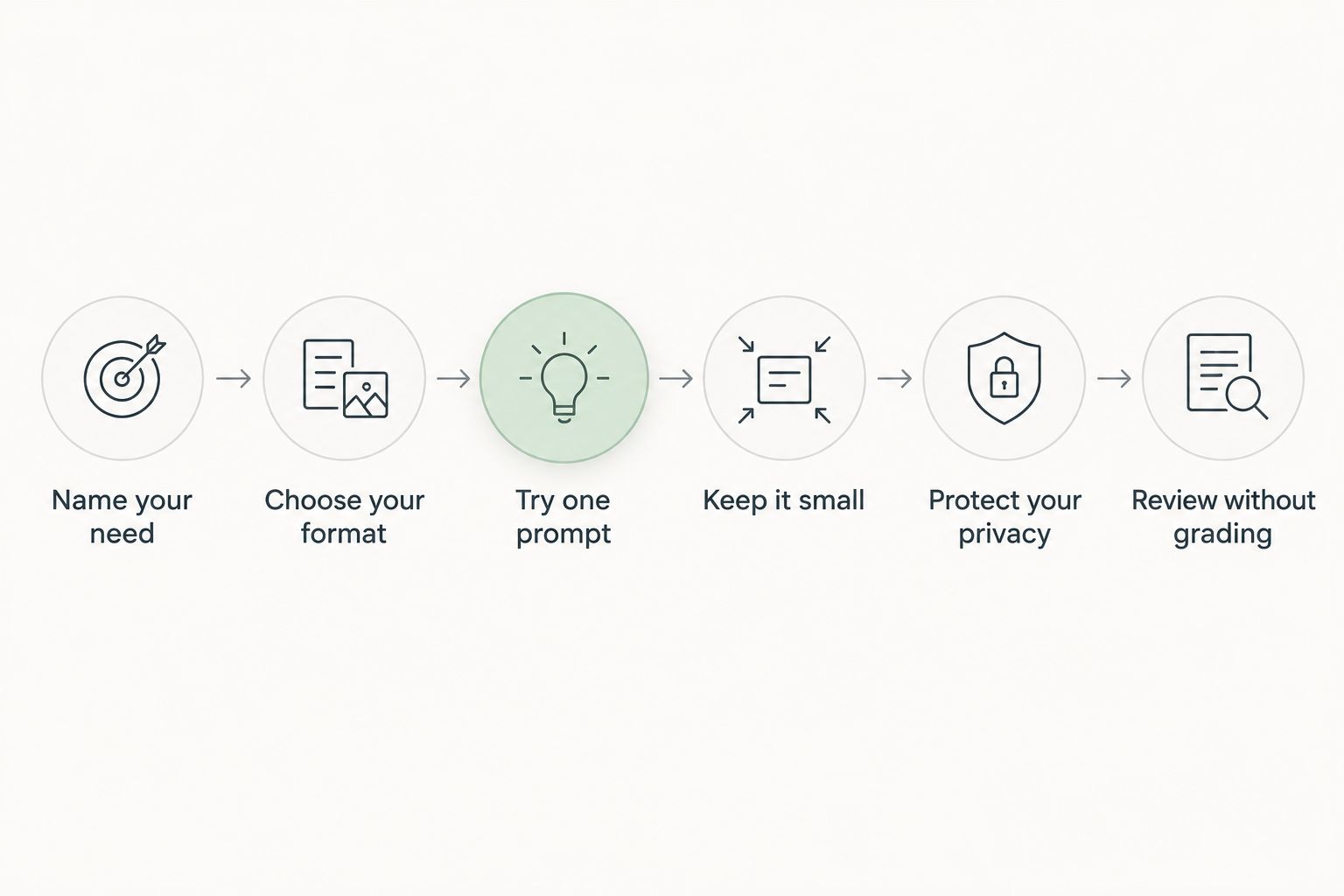
These steps move from choosing a subject to deciding what, if anything, comes next. You can return to an earlier step whenever your needs change.
Which journaling option fits what you need?
There isn’t one format you have to graduate toward. A blank notebook is not less serious than a guided journal, and buying a journal does not commit you to answering every page.
For 2026, choose according to the obstacle in front of you: needing a question, wanting open space, preferring to type, or wanting to try reflection before choosing a dedicated notebook.
| Option | Best for | What it offers | Key limitation |
|---|---|---|---|
| Blank notebook | Women who want open-ended writing | Freedom to choose the subject and entry length | You supply the starting question |
| Prompts in this guide | Women who want to try before choosing a journal | Questions you can use with materials you already own | You arrange and keep your own entries |
| Guided self-care journal | Women who want questions on the page | A starting point for reflection | The selected prompts might not match your needs |
| Private digital document | Women who prefer typing | A place to write and edit without handwriting | Privacy depends on device and account access |
Hellolesliecreative is best for women seeking self-care journals alongside personal writing about new beginnings. That fit doesn’t mean every journal will be right for every reader; choose by the individual description and the kind of reflection you want.
If you prefer completely open writing, keep the blank notebook. The point is to find a usable place for your thoughts, not to persuade yourself that you need a different format.
Common mistakes when journaling through a new beginning
Turning reflection into a reinvention project
A journal can become another place to demand a new career, a calmer personality, and a fully planned future from yourself. Keep the question close to the day you’re actually living: What needs my attention now?
Forcing gratitude before naming the difficulty
You can appreciate parts of your life and still feel disappointed, lonely, or uncertain. Don’t make a positive ending the price of being allowed to write the difficult sentence.
Answering prompts that don’t fit your life
Questions about partners, children, work, or family can carry assumptions that don’t match your circumstances. Rewrite the question around your actual relationships and responsibilities, or leave it entirely.
Treating a missed entry as a broken promise
You don’t have to account for the days between entries. Date the next page if you want to, then begin with what matters now rather than an apology for your absence.
Asking the journal to provide all your support
Writing is a reflection practice, not treatment. If distress persists, interferes with daily life, or leaves you feeling unsafe, seek appropriate professional support rather than asking yourself to journal your way through it alone.
FAQ
What is a guided journal for women?
A guided journal for women provides prompts to help you begin reflecting without choosing every topic yourself. The useful distinction is whether its questions fit your needs, not simply whether its cover or description says it is for women.
What’s the best guided journal for a woman starting over in midlife?
The best fit is a journal whose questions you can answer honestly without feeling pushed toward a particular outcome. Read the individual description and any available sample pages, and choose room for your actual life rather than an idealized new beginning.
Is a guided journal better than a blank notebook?
A guided journal is better when finding a starting question is your main obstacle; a blank notebook is better when you want open-ended space. Neither format requires you to write daily or finish every page.
What should I write when I don’t know where to begin?
Begin with: Right now, I need somewhere to be honest about… Finish with whatever words come, or write one practical thing you need today. You don’t need to explain your whole situation.
Do I have to journal every day?
No, you do not have to journal every day. Choose a rhythm you want to return to, and begin again without making up missed entries.
Can I skip questions in a guided journal?
Yes, you can skip or rewrite any question. A prompt does not become an obligation because it is printed on a page, especially when its assumptions do not fit your circumstances.
Can journaling replace therapy?
No, journaling is not a replacement for therapy or other professional support. Use it for reflection and self-care, and seek appropriate help when distress persists, affects daily life, or creates safety concerns.
One last thing
Your first entry doesn’t have to be about the change itself. You can begin with the conditions that would make writing feel possible: I need privacy. I don’t want advice right now. I want to leave this question open.
Those sentences count as a beginning. Before you decide what to write next in 2026, let yourself decide what the page is allowed to ask of you.