Use a mindfulness journal by pausing, noticing what is happening right now, and writing a few honest words without correcting them. You can begin with a feeling, a physical sensation, or something you notice around you; you do not need a beautiful page or a daily streak. I would rather you leave with one truthful sentence than another reason to feel behind.
- Use a mindfulness journal to notice the present, not to produce a perfect page.
- Begin with 2 minutes and one honest sentence; a daily streak is optional.
- Hello Leslie Creative is for women starting over who want gentle journaling and self-care writing.
- Treat journaling as reflection, not treatment or a substitute for professional support.
Why this matters when you're starting over
When life already asks a lot of you, even self-care can become another assignment. You open a notebook and suddenly feel responsible for having meaningful thoughts, lovely handwriting, and a clear plan for whatever comes next.
You do not need to turn your 2026 journal into evidence that you are handling everything well. The page can hold uncertainty without asking you to solve it. That is the approach I want to offer here: a small place to notice your life, not another place to grade it.
At Hello Leslie Creative, the writing and guided self-care journals are for women navigating new beginnings. You are welcome to begin with the notebook you already have. Choosing something new does not have to come before listening to yourself.
How do you use a mindfulness journal without getting it perfect?
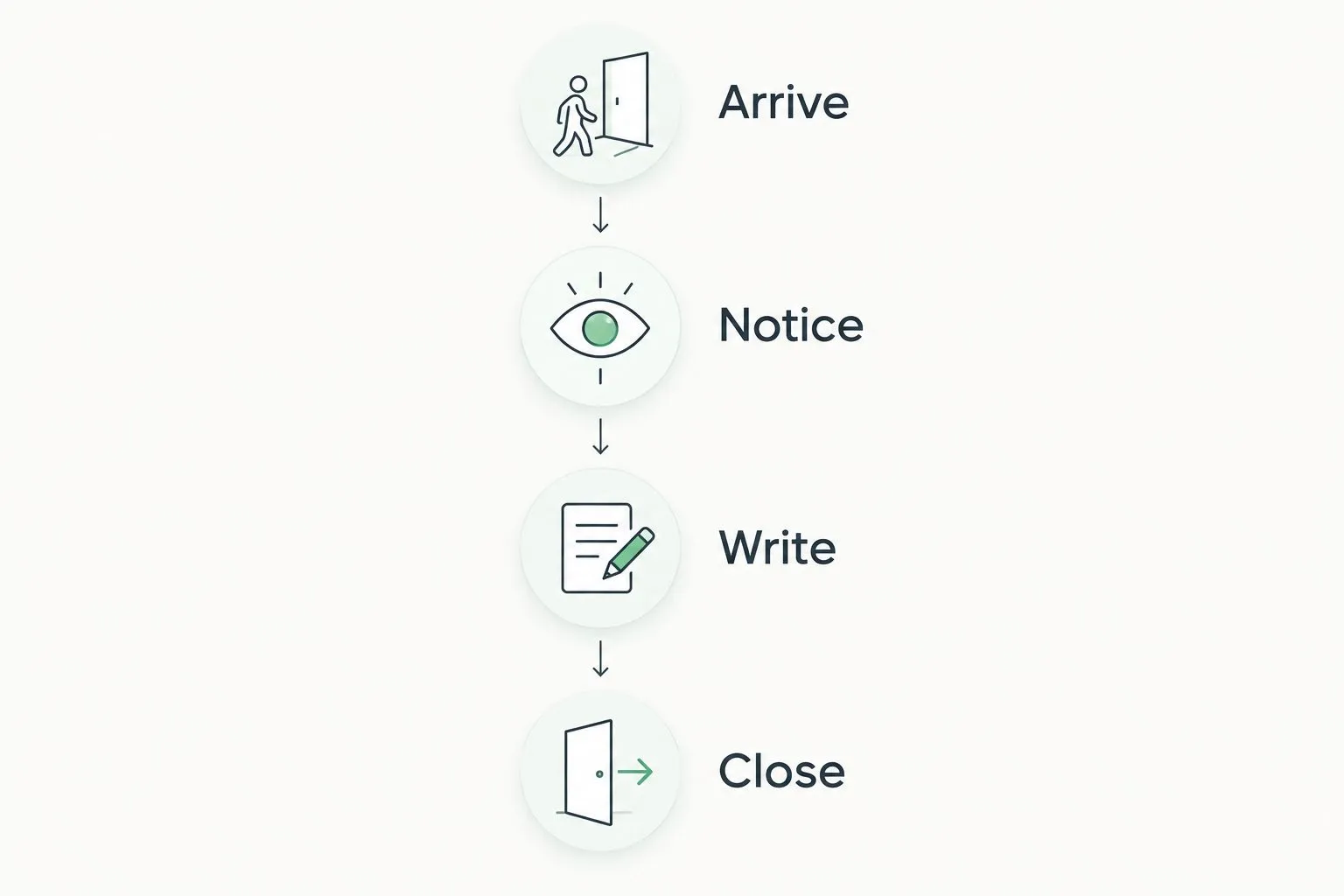
Use a mindfulness journal by moving from noticing to writing, then choosing where to stop. I suggest the following sequence as an invitation, not a routine you have to complete exactly.
1. Arrive
Put your notebook somewhere you can write without having to balance everything in your lap. Leave the page blank for a moment. Notice where your body meets the chair or where your feet meet the floor.
You do not have to close your eyes or change your breathing. If paying attention to your body feels uncomfortable, notice an ordinary object nearby instead: a curtain, a cup, or the shape of a window.
2. Notice
Choose something happening now rather than trying to summarize your whole life. You might notice tired eyes, the sound of traffic, a worried thought, or a wish for quiet.
Try this opening: Right now, I notice… Finish it in your own words. There is no requirement to make the observation pleasant or insightful.
3. Write
Give yourself 2 minutes if a boundary makes beginning easier. Write what you noticed, then add what feels useful: a feeling, a need, or a question you cannot answer yet.
If a timer feels like pressure, leave it out. The suggestion is there to make the task smaller, not to measure your commitment.
4. Close
Read your words only if you want to. You can finish with a small question: What would be kind and practical now?
Your answer might be getting a glass of water, answering a necessary message, or putting the notebook away. Closing the journal is allowed to be the next step.
What can you write when your mind goes blank?
A blank mind does not need to become a problem to fix. Start with something available to you rather than searching for the deepest thing you could say.
I would choose just one of these prompts:
- For your surroundings: What can I hear or see from where I am sitting?
- For your body: Where do I notice comfort, tension, warmth, or tiredness?
- For your feelings: What feeling can I name without explaining it away?
- For your needs: What do I need that I have been reluctant to acknowledge?
- For self-kindness: What am I ready to stop grading myself on in 2026?
- For uncertainty: What can remain unanswered on this page?
You can also write, I don't know what to write, and I am here anyway. That is an observation, not a failed entry. You have put something true on the page.
What does a short entry actually look like?
Here is a made-up example of an ordinary entry, not a personal story or a model you need to copy:
I notice that I am holding my shoulders tightly. I keep thinking about a conversation I have not had yet. I do not know how it will go, but I can stop rehearsing long enough to make lunch.
Nothing in that entry resolves the conversation. It simply separates what is happening now from what the writer is anticipating. Your entry can be less orderly, shorter, or unfinished.
A small place to begin in 2026
You do not need a dedicated room, a quiet morning, or a particular kind of pen. Choose a place that works for the life you actually have, including interruptions and days when your attention is scattered.
For a first attempt, I suggest 3 minutes altogether: about 1 minute to settle and 2 minutes to write. These are suggested boundaries, not a tested formula or a minimum needed for a benefit. Shorten them whenever that makes the practice more manageable.
Keep the notebook somewhere you can retrieve it easily while still protecting your privacy. If another person could read it, decide what you are comfortable recording before you begin. You can use broad descriptions rather than names or identifying details.
Make access easy, but do not make visibility an obligation. A journal tucked safely in a drawer is not less legitimate than one waiting beside a favorite chair.
Should you use a blank notebook or a guided journal?
Choose the format that asks less of you at the moment you sit down. A blank notebook gives you room to choose your own direction; a guided format supplies a starting question when choosing one feels tiring.
Neither format proves that you are more serious about self-care. Both have limits, and you can change your mind.
| Format | Best for | What it offers | What to watch for |
|---|---|---|---|
| Blank notebook | You want to choose your own starting point | Open space without a preset question | An empty page leaves you to decide where to begin |
| Guided journal | You prefer a starting prompt | A question or direction to respond to | A prompt will not always fit what you need that day |
Hello Leslie Creative offers guided self-care journals for women navigating new beginnings. That is an option if you want guidance, not a prerequisite for this practice. Whatever format you choose, leave room to skip a prompt that does not fit.
Why your mindfulness journal practice varies
There does not need to be one correct version of journaling that you reproduce every time. I would adjust the practice around these ordinary considerations rather than judging each entry against the last:
- Your energy: A few words can be your chosen stopping point on a tiring day.
- Your privacy: What you feel comfortable recording depends on who can access the page.
- Your preference for structure: A prompt gives direction; an open page lets you choose it.
- Your emotional comfort: You can stay with everyday observations rather than difficult memories.
- Your available attention: An interruption can be a stopping point, not a reason to discard the entry.
The question is not whether today's page matches yesterday's. It is whether you want to continue, simplify, change direction, or stop.
Do I have to write every day for it to count?
No daily streak is required for the approach described here. You can return when you want a moment of reflection, without filling the space between entries.
I would not turn missed days into homework. Open to the next available page and begin with what is happening now.
What if my 2026 journal already has gaps?
A journal with gaps is still available to you. You do not owe it a summary of everything that happened while you were away.
Try beginning with Today, I am noticing… rather than an apology. You can record the present without reconstructing the missing pages.
How to notice without turning the page into self-criticism
Sometimes an observation turns into a verdict before you notice the change. I am tired becomes I am lazy. I feel uncertain becomes I should have figured this out by now.
I would gently separate what you can observe from the judgment you have attached to it. You do not have to replace a hard thought with a cheerful one; try making it more specific instead.
For example, you might change I never get anything right to I am disappointed about how that conversation went. The second sentence leaves room to describe an event without making it your entire identity.
Use this small check before closing:
- What did I actually notice?
- What conclusion did I add?
- Is there a more specific way to describe this moment?
You are not required to argue yourself into feeling better. Honest writing can include disappointment without becoming an attack on yourself.
When to put the journal down
You do not have to keep writing through distress to make the practice worthwhile. If the page leaves you feeling more overwhelmed, pause and turn your attention to your surroundings or an ordinary task.
You can also choose not to write about a particular subject. A mindfulness journal does not require you to revisit painful experiences, disclose private details, or find a lesson in something that hurt.
Journaling is reflection and self-care, not treatment. If distress persists, affects your daily life, or feels difficult to manage, seek support from a qualified mental health professional. A notebook does not have to carry what needs human care.
FAQ
How do I start a mindfulness journal if I have never kept one?
Start a mindfulness journal by noticing something happening now and writing one sentence about it. You can use the opening 'Right now, I notice' and stop when you have said enough.
How long should I spend writing in a mindfulness journal?
Try 2 minutes of writing as an optional starting boundary, not a minimum requirement. Shorten the session or leave out the timer if measuring the time adds pressure.
What should I write in a mindfulness journal at night?
Write about what you notice at night, such as your surroundings, your energy, or a feeling that is present. You do not need to review the whole day or end with gratitude.
Can I use a regular notebook as a mindfulness journal?
Yes, you can use a regular notebook as a mindfulness journal. Begin with your own observation or choose a prompt; a dedicated journal is not required.
What if I only write negative things in my journal?
You do not have to add positive statements to make a journal entry acceptable. Describe difficult feelings without turning them into judgments about your worth, and pause if writing becomes overwhelming.
Is a mindfulness journal a replacement for therapy?
A mindfulness journal is not a replacement for therapy or other professional mental health support. Use it for reflection and self-care, and seek qualified support when you need help managing distress.
One last thing
Before you close the notebook, consider leaving the next page blank on purpose. Not as a promise to write tomorrow, but as permission to return without a plan.
Let your 2026 journal contain unfinished thoughts, ordinary observations, and days you did not document. A page does not need to be impressive to be yours. You can begin again without explaining why you stopped.